
Maybe your organization bought AI licenses months ago, and a handful of people use them every day while most opened them once. Maybe you’re still deciding which tools to buy. Either way, the CEO asks the same question: “What’s our AI enablement plan?”
Deloitte’s 2026 State of AI in the Enterprise survey of 3,235 business and IT leaders found that the share of workers with sanctioned AI tools grew from under 40% to about 60% in a single year. Yet only 34% of companies say they’re using AI to “deeply transform” their business. Most workers got access. Far fewer companies changed how the work gets done. If you’re still choosing tools, that’s useful news: the hard part comes after the purchase.
AI enablement is helping your whole organization use AI really, really well. Choosing and buying the tools is step one. The rest is training for each role, a clear policy, a culture that brings people along, attention to how people feel, and measures that show it’s working. Here is that map, and the roadmap we build with our clients.
- AI enablement: the work of getting every person in a team or organization skilled at using AI in their own job, because having the tools is not enough when the work itself changes.
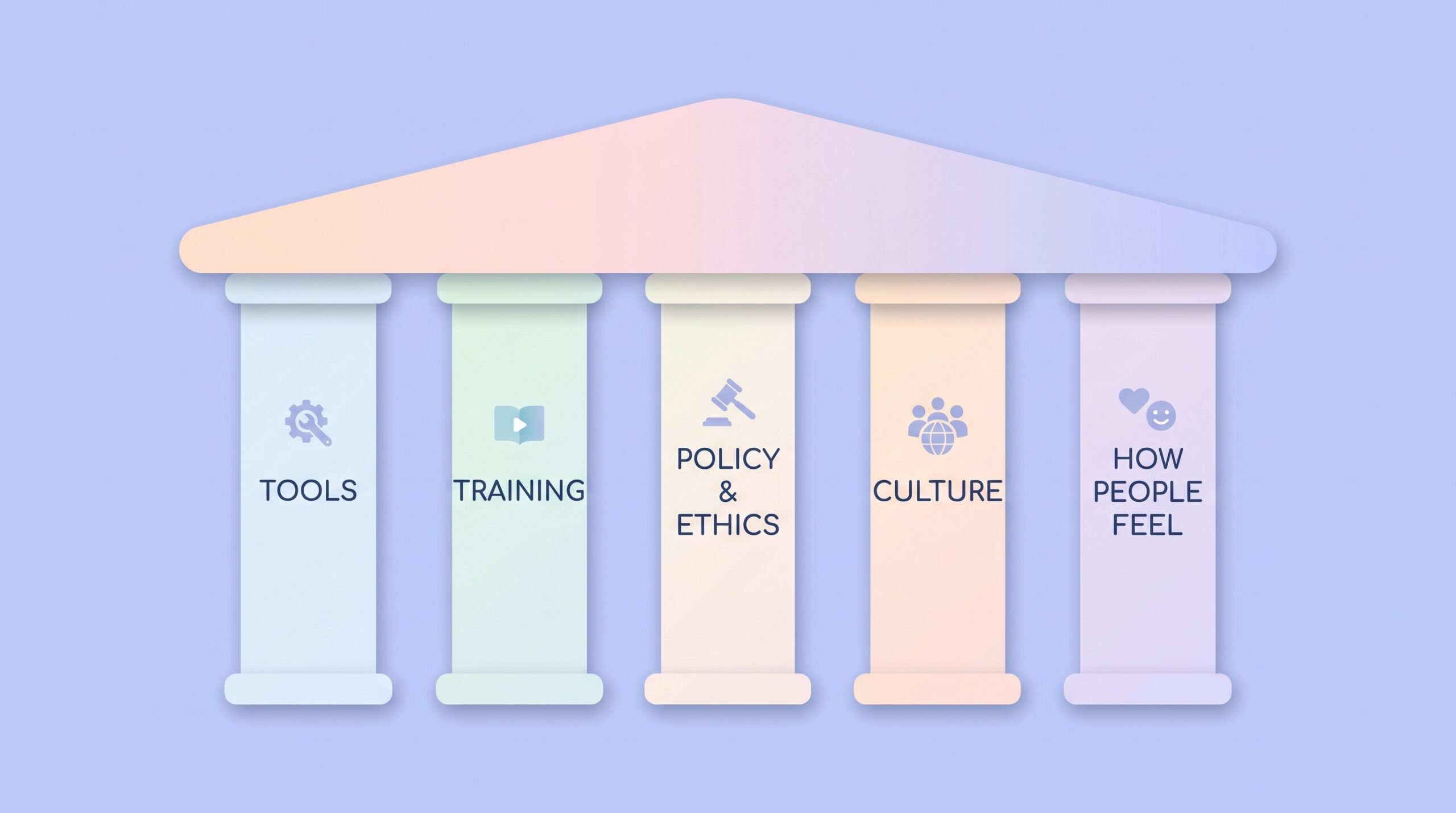
- A good AI enablement strategy gives five parts equal weight: tools and their cost per person, training for each role, policy and ethics, culture and change management, and how people feel about AI.
- Build the roadmap in order: find out where the company, each team and each person stands; settle tools and policy; set your measures before you spend on training; train in tiers and grow champions; then keep it going with refreshers and a regular time to share what works.
- One person with executive authority coordinates it, and the whole organization does the work, so champions inside each team matter more than any outside trainer.
- What is AI enablement?
- What does a good AI enablement strategy cover?
- How do you build an AI enablement roadmap?
- Where should you augment, and where should you automate?
- Why does AI enablement stall?
- Who owns AI enablement?
- How do you measure AI enablement?
- FAQ: Questions leaders ask about AI enablement
- How AI Learning Labs builds an AI enablement roadmap
What is AI enablement?
AI enablement is helping a team or organization use AI really, really well, every person in their own work, which takes far more than buying licenses. Having the tools is not enough, because this is a completely different way of working.
Most definitions online agree on the basics: AI enablement prepares a company to use AI at scale, and it’s different from buying tools. I’d add two concrete differences that matter when you build the plan.
First, buying tools gives people access, and enablement gets them using it. A license is a login. Enablement is the training, policy and support that turn the login into a new way of working.
Second, AI training is one part of AI enablement, not all of it. Enablement also decides which tools people get, what they cost, what the policy allows, how the culture changes and how you’ll measure the result. It sits inside an AI adoption framework, the bigger plan for where AI goes in your organization.
Here is what that looks like in practice. One client of ours gave everyone Microsoft Copilot and a basics track, and opened Claude only to people who went through a deeper training. Deciding who gets which tool after which training is one part of AI enablement. So what does the whole plan cover?
What does a good AI enablement strategy cover?
A good AI enablement strategy covers five things: tools and cost, training for each role, policy and ethics, culture and change management, and how people feel. Most plans give nearly all their attention to tools and training. I give the five equal weight, because the people side decides whether the tools get used.
Stefano Puntoni, Sebastian S. Kresge Professor of Marketing at the Wharton School, makes the same case in Wharton’s 2025 AI Adoption Report: “Companies that invest in training, culture, and guardrails will be the ones that turn Everyday AI into long-term advantage.”
Tools and what they cost per person
Start with the tools themselves. What tools do we need? How do we make sure everyone has access? What are the right settings? How do the tools work together so people can use them widely and easily? When we’re in organizations, we tell them one LLM for your team is not enough. Make sure you have at least two, so your team always has access to the help they need and no one depends on a single model.
Then get an honest cost per employee. When Microsoft announced pricing for Microsoft 365 Copilot in July 2023, it set the add-on at $30 per user per month, on top of the base license. A seat price like that is one line of the cost. Token use, a second LLM and the training make up the rest. That is why the client above opened Claude only to its champions: the company wanted to be sure the token cost was worth it.
Training for each role
Everyone needs the basics. After that, training should follow the work people do. Making slides in PowerPoint is very different from working with data in Excel, which is very different from writing strategy documents. One course for the whole company teaches none of those well. That is the core of any good AI training workshop program for teams: shared basics first, then sessions built around each group’s real outputs.
Policy and ethics
Every organization needs a clear policy on which tools people can use and how they can use AI. Some of it differs by industry, so look at the rules your field already follows before you write it. Write the policy with your staff, not against them. We walk through the policy categories most organizations need in our AI policy guide.
Ethics goes past compliance. At the workplace level, the questions are practical ones. Who splits the time AI saves? Are we just loading a few people with more to do? Who’s responsible when an AI decision made inside the company has ramifications?
Culture and change management
Once leadership agrees on the goals and the tools, the other half of AI enablement is making your team feel seen and understood, and bringing them along with a change management plan so they’re excited to take the trainings. Start with a culture check. Who does your organization say it is? What values and cultural tenets do you already have in place? How does your new AI program further those values? The goal is to build your workforce and your culture, not diminish them.
How people feel about AI
Name the fears plainly, because your people already feel them. Will they be asked to do even more with less? Will they become expendable? Do they have ethical doubts about what AI could mean for humanity? In a Pew Research Center survey published in 2025, 52% of U.S. workers said they were worried about the future impact of AI in the workplace, and 33% said they felt overwhelmed. About half the people in your training will walk in worried. People do have moral, ethical and emotional experiences around AI, so plan for those feelings the way you plan for licenses. As you check in on how people feel, watch for the opposite of fear, too: overuse. With the organizations we work with, we ask leaders to be very aware of how they could be pushing colleagues to brain fry, the new term for what happens when people overuse AI until they’re too exhausted to think clearly.
So in what order do you build all of this?
How do you build an AI enablement roadmap?
Build an AI enablement roadmap in this order: find out where the company, each team and each person stands, settle tools and policy, set your measures, train in tiers, then keep it going.
- Assess. Where are the company, each team and each person with AI today? Where does each person’s day go? How do they feel about AI?
- Settle tools and policy. People can’t train on tools they don’t have, or under rules nobody has written yet.
- Set your measures. Decide what success looks like before you spend money on training.
- Train in tiers. A baseline for everyone, and more for the people who want to go further.
- Keep it going. Refreshers and a regular time to share what works, because the tools keep changing.
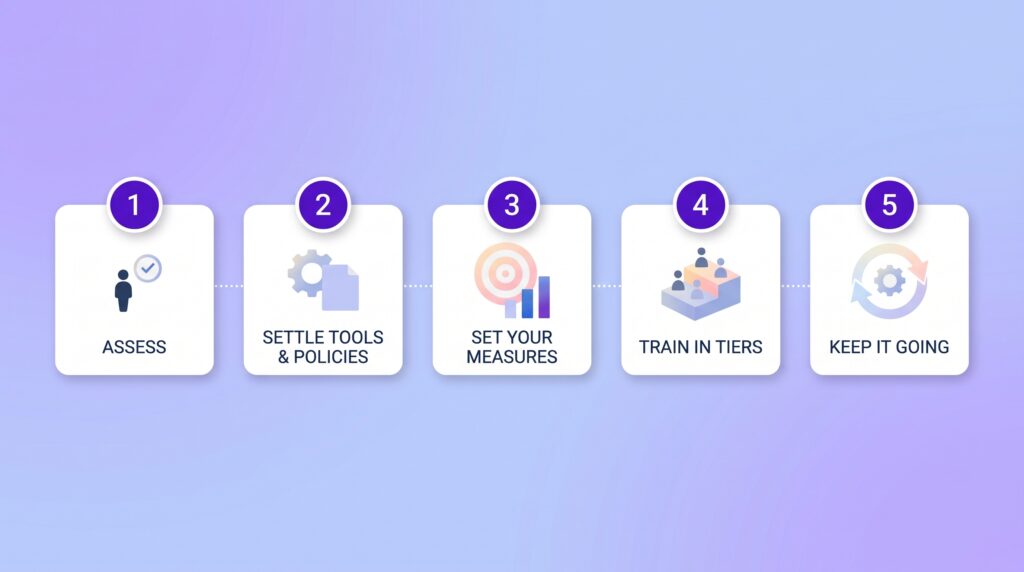
The order is the point. Train before tools and policy are settled, and the training goes to waste. Measure after you spend, and you can’t see the return. Train everyone the same way, and you’ll bore some people and lose others, because not everyone in your organization can become advanced. Skip the last stage, and the skills fade as the tools change.
At our free “Imagine: The Future of Work” Monthly Forum in July 2026, an education-program lead asked the question every leader building a roadmap runs into: “Does everyone need to know everything?”
My answer was a client we were working with at the time. Together we created two training tracks. Track one asked a simple question: what are the basics that everyone can do better? The emails, the meetings, the synthesis. Everyone got Microsoft Copilot and training on those everyday tasks, with a clear goal: help each person get 5 to 10 hours a week back.
Track two opened Claude to the people we call champions. To get access to Claude, they go through a deeper training first, so the company feels the investment and the token cost are worth it. Inside each track, the trainings split by output, because building slides, analyzing data and writing strategy documents each take different skills
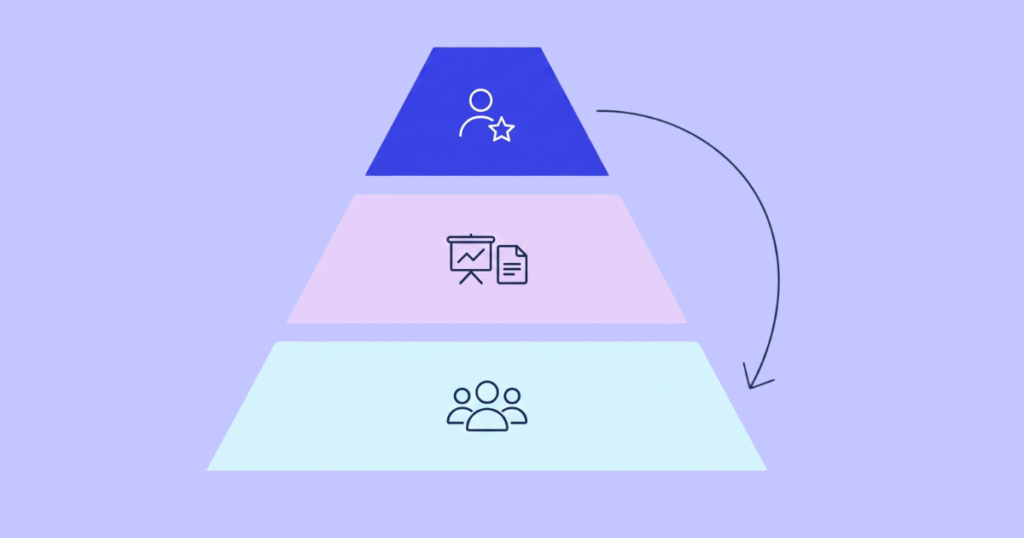
From there, people grow at their own pace. Many become moderate prompters. A smaller group, the champions, choose to go deeper and invest the time it takes to become advanced prompters. In our experience, about one in 10 to one in 20 people in a workplace take to AI naturally, so you are looking for a few people, not everyone.
Part of an AI enablement strategy is identifying who those people are. I believe there is nothing more valuable to an organization than someone inside it who becomes an advanced prompter, with advanced context management skills, and can then help other people with their projects and work.
That is the champion’s job, and you see it outside client programs too. Joshua Cooper, a small business owner in accounting services who trained with us in 2025, put it in one line: “And now I’m teaching my team to do the same.”
Training is only one place the money goes. The bigger question is whether to put it into augmentation or automation.
Where should you augment, and where should you automate?
Augment first, wherever your people’s expertise has to lead the work, and automate only the processes that can run on their own. In augmentation, a person works with AI at every step: prompting, reviewing what comes back and deciding what to keep. In automation, the process runs on its own. A person may still check the result at the end, but their expertise is no longer leading the work.
A good AI enablement strategy knows how to map where an organization or team needs automation versus augmentation, and has a clear roadmap for how to invest its resources for the biggest gains. That map weighs four things: your resources, your people’s skill, your culture and how bought-in your leadership is.
The choice matters because the work is changing fast. Citing the World Economic Forum’s Future of Jobs Report 2025, SHRM reports that 44% of workers’ core skills will change within the next five years, and it describes two models companies are using: one that replaces people with AI and one that augments them. If nearly half of your people’s skills are about to change, you are deciding whether to invest in people who can do the new work with AI or in systems that do it without them. For most work, I’d start with the people.
Here is our honest limit: we’re not an automation company. We know some great automation vendors. But we’ve seen a lot of organizations skip augmentation and team training and go straight to an AI system or vendor. We caution against those large technical investments unless you really know what you’re doing and you’re working with a vendor you really, really trust. If you’re deciding where augmentation fits, start with what AI augmentation means for a team.
Even with the right map, plenty of rollouts stall anyway.
Why does AI enablement stall?
AI enablement stalls for three reasons: tools arrive without training, training gets forced on people, and leaders treat it only as an efficiency project.
Tools without training is the most common. In BCG’s AI at Work 2025 survey of more than 10,600 leaders, managers and frontline employees, only one-third of employees said they had been properly trained, and regular use was sharply higher for employees who got at least five hours of training. Put another way, two out of three employees are working with tools nobody properly taught them to use.
Forced training is the second. Many of our clients don’t want to force everyone to use AI for everything, and we don’t build compulsory training, because training lands when people are excited to take it. The best adoptions we’ve seen happen when there’s room to talk through the ethical questions and people can find their own level of comfort.
The third is treating AI only as an efficiency measure. When people feel the training is about empowering them and helping their own professional development, and not just an efficiency measure for the company, we see better and faster adoption. Leaders and managers need to think about adoption through more than the lens of efficiency. These tools are not like any software we’ve had before. This isn’t teaching people how to use PowerPoint.
So who keeps all of this moving?
Who owns AI enablement?
One person should coordinate AI enablement, someone with executive authority, while the whole organization does the work. AI enablement is not just a job someone owns. But someone has to bring the pieces together so there is a clear pathway for tools, policy and training. Usually that is one of the executive leaders, or someone working with an executive’s authority, who pulls in HR, legal and compliance, and the technology vendor or in-house tech person.
The coordinating role is turning into a real job title. In August 2026, Capital One posted a “Director, AI Learning Enablement” role, responsible for “creating and delivering our enterprise learning roadmap.” Whether you hold a title like AI enablement lead or the CEO just handed you the question, the job is coordination, not doing every piece yourself.
The rest of the work sits with managers and champions. Gallup found in 2025 that employees who strongly agree their manager supports their team’s AI use are 2.1 times as likely to use AI a few times a week or more. Yet only 28% of employees in organizations implementing AI strongly agree their manager actively supports it. Most managers haven’t yet stepped into the part of the work that moves usage the most.
So how do you know any of it is working?
How do you measure AI enablement?
Measure AI enablement against goals you set before you spend on training: hours saved, skills gained, and the return on tools and training, tracked separately. Put the measurement framework together first. What are your goals? How many hours can be saved? What tasks and skills can people learn to do with AI? How will you measure the impact of the investment person to person and team to team?
Track two returns, not one: the investment in the tools and the investment in the training. If usage stays low, you need to know whether the tools are wrong for the work or the training didn’t land, and one blended number can’t tell you which.
Set your targets as ranges, and expect them to differ by group. For an everyone track like the one above, we aim for 5 to 10 hours a week back. Students in our bootcamp report saving 10 to 20 hours a week. Training belongs in the return you measure: in a DataCamp-commissioned YouGov survey of more than 500 U.S. and UK business leaders, reported by CIO Dive in March 2026, just over 1 in 5 leaders reported significant positive ROI from AI overall, against 42% at organizations with mature AI-literacy upskilling. For the two-track client, these measures answer the question the plan started with: was the token cost worth it?
FAQ: Questions leaders ask about AI enablement
The first roadmap comes together quickly, and the skills take months. Our team programs run four to six weeks, and bootcamp students report about 10 hours a week back early on, then 15 to 20 hours after three to six months of applying the method. Tools keep changing, so plan a regular rhythm of refreshers and sharing after the training ends. Start by scheduling the assessment, since everything else is sized from it.
AI training is one part of AI enablement. Training is a class. Enablement decides who takes which class, on which tools, under which policy, and how you’ll know it paid off. If you have a training budget but no roadmap, build the roadmap first.
Bring in help when the licenses are bought and use has stalled, when leadership can’t settle tools or policy, or when no one inside has the advanced skills to be your first champion. If you already have an advanced user with executive backing, you can run the first roadmap yourselves. Either way, the eight steps below are the ones we use, and they start with four questions for leadership.
How AI Learning Labs builds an AI enablement roadmap
AI Learning Labs builds every AI enablement roadmap in the same eight steps, starting with four questions for leadership, whatever stage the organization is at. You can copy them for your own plan.
- Four questions for leadership. Who are the decision makers? What do they have in place? Where are the gaps? Is there buy-in? We don’t disqualify any organization; the answers decide where we start, never whether we work together.
- Assessment at three levels. We ask every person where they are with AI today, where their day goes, and what feelings and concerns they have about AI, then read the answers by team and for the whole company.
- Tools and cost. We map which tools and LLMs each team needs and give leadership an estimated cost per employee, token use included.
- Policy. We check the policy against the categories it needs, and leadership decides what’s approved before anyone trains on it.
- Culture, ethics and the emotional. We hold a culture check against the organization’s own stated values and plan how to bring people along, so they want the training.
- Measures before money. Leadership sets the goals and the hours to watch, and we take a baseline before the first class, so there is something to compare the results against.
- Tiers and champions. We train a baseline for everyone, moderate skill in each team’s core outputs, and deeper training for the champions who choose it.
- Keep it going. We set up a monthly hour to share what worked and what didn’t, refresher classes, and a learning stipend for people who want to go deeper, so the team keeps building without us.
Steps 1 and 2 are the assessment stage of the roadmap above. Steps 3 to 5 settle tools, policy and the people plan, step 6 sets the measures, and steps 7 and 8 are training in tiers and keeping it going.
The two-track plan earlier in this article came out of steps 2, 3 and 7. Right now we’re building these roadmaps with a biotech company, with nonprofits and development organizations, and with mid-size companies. When we come in and train, we empower the team to start working in a new way and keep building those skills on its own. That is how our team AI training works, and it always starts with step 1.
So when the CEO asks for your AI enablement plan, you don’t have to answer with a list of tools. Answer with a first step: put the four leadership questions on the agenda of your next executive meeting, and let the answers decide where your roadmap starts.
Ready to build your roadmap?
Book a Consultation, and we’ll start with those same four questions. If your organization doesn’t have a budget for private training yet, you can send individuals to our quarterly public AI Bootcamp.
About the author
Nathaniel Reagan is a co-founder of AI Learning Labs, with 700+ professionals trained. For 20 years he has worked as a consultant and fractional executive across development, biotech, pharma and health tech, helping organizations adopt new technology. PR News named him one of its 15 to Watch for leading Fortune 100 companies through the adoption of digital and social media at scale. Today he builds AI enablement roadmaps with teams and leads curriculum for AI Learning Labs.
EXPLORE TOPICS