
Friends have asked me some version of this: “Can’t I just get all of this from watching stuff?” My answer is yes. Absolutely. Please go to YouTube and take online video training. There’s a lot of good free material out there, and I hope you use it.
I’ll be upfront: I co-founded AI Learning Labs, and I teach its live AI bootcamp, so weigh what follows with that in mind. If you’re weighing an AI bootcamp vs online course, here’s the question I’d ask first: do you want information, or do you want to change how you work? An online course is good at the first. A bootcamp is built for the second. What a video can’t do is notice where you get stuck, look at your homework each week, and follow up with you when you fall behind.
- Choose an online course if you want to learn what AI tools can do, or how AI works, at your own pace and for little or no money.
- Choose an AI bootcamp if you want to change how you work and you know you need someone checking your homework and following up when you fall behind.
- Paying helps people finish, but it isn’t enough. In MIT and Harvard’s open online courses, about 3% of all participants finished, against 46% of those who paid, so more than half of paying learners still didn’t finish (Science, 2019).
- Before you buy any bootcamp, ask who checks your setup, whether you work on your own project, and how often the material is updated.
- What is the difference between an AI bootcamp and an online course?
- AI bootcamp vs online course: which should you choose?
- Which will you finish, an AI bootcamp or an online course?
- How do you tell if an AI bootcamp will change how you work?
- How much does an AI bootcamp cost vs an online course?
- Should you take an online course before an AI bootcamp?
- AI bootcamp vs online course: frequently asked questions
What is the difference between an AI bootcamp and an online course?
An online course gives you information about AI; an AI bootcamp is built to change how you work with it. By online course, I mean the self-paced kind: recorded lessons you watch on your own time, often with a quiz at the end. By AI bootcamp, I mean a live, scheduled program where you practice on a project and someone reviews what you make. Both come in other formats too, and we map the main formats of online AI courses in a separate guide. Here’s how the two line up when you put an AI bootcamp vs online course side by side.
AI bootcamp vs online course at a glance
| Self-paced online course | Live AI bootcamp | |
| What you get | Recorded lessons and information, taken at your own pace | Live classes, practice on a project, and someone reviewing your work |
| Cost | Free (Elements of AI) to about $59 a month (Coursera Plus); Google AI Essentials on Coursera is $49 a month | Varies widely. For tech-career bootcamps, about $1,000 to $5,000 at the lower end, and one 2026 review puts the average near $13,584. Ours uses a sliding scale |
| Time | A few hours to a few weeks (Google AI Essentials: under five hours, by Google’s count) | Fixed weeks (ours: four weeks at about three to four hours a week, plus a week of onboarding) |
| Schedule | Whenever you like | Set live class times (ours records every session within 24 hours) |
| Feedback | Usually automated quizzes, if any | Someone reviews your homework each week |
| Accountability | You | Follow-up when you fall behind, and a cohort expecting you |
| Your own project | Usually the course’s own exercises | One real project from your work, or a passion project |
| Kept current | Recorded once, so it ages as the tools change | Updated as the tools change (ours: every month) |
| Completion | About 3% of all participants in MIT and Harvard’s open courses; 46% of those who paid (Science, 2019) | No independent figure for AI bootcamps. HBS Online self-reports 85% for its own cohort courses; ours isn’t published |
Why does that difference matter so much? My whole career has been in behavior change communication, including five years in Mozambique working on HIV behavior change. The question in that work is always the same: how do you teach people something in a way that helps them change what they do? It’s not a rational process. People know plenty of things they should do and still don’t do them. Behavior change is about understanding how irrational humans are, and looking for the points where people resist learning. Learning AI works the same way. I tell my students that if I could get people to wear condoms and get tested for HIV, I can get them to open up Gemini.
Most professionals already know AI matters. What they don’t have yet is the habit of reaching for it in the middle of a busy workday.
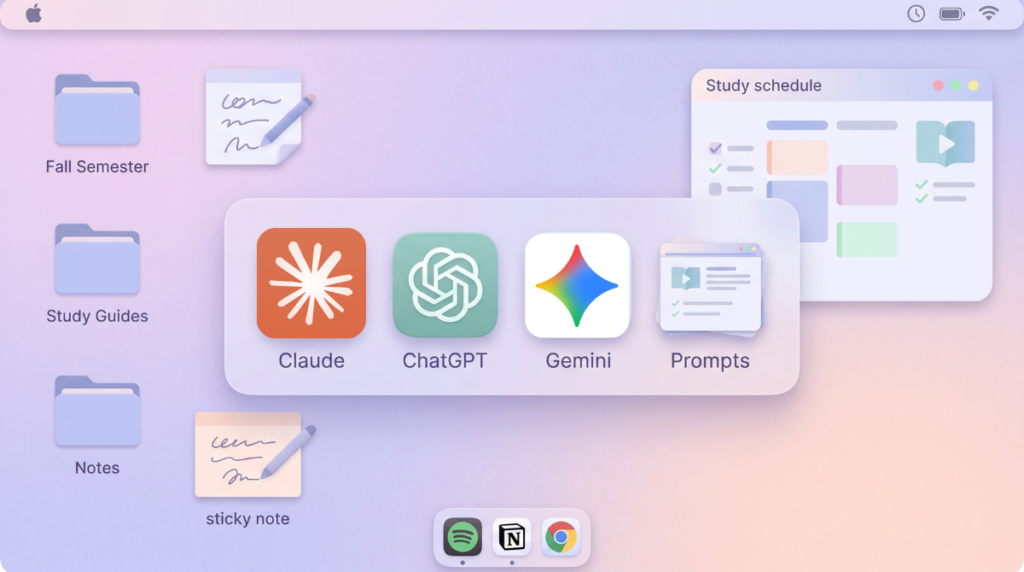
Here’s what that looks like in practice. In the first week of our bootcamp, every student sets up their computer so every AI tool they use, and their prompt library, sits one click away. If you have to click two or three times to find an app, you won’t use it. If it’s one click away, you’ll think, “Let me try this in Gemini really quick.” Each student then pastes a screenshot of their setup into our community chat, and in the first two weeks we check every one. It’s such a simple thing, and it’s these simple things that make live learning different. A video can tell you to organize your desktop. Nobody checks whether you did.
Students notice the difference too. An operations manager at a small business in our May 2026 cohort, who had tried other programs, told the class that most of them “are teaching you the technical tasks. Click here, add that, connect this… but they’re not teaching you how to… dissect, decipher, put the puzzle back together.”
A course can show you the buttons, which tools to use and a few steps to follow. That’s not the same as having someone help you think through your own project, your role and your goals
AI bootcamp vs online course: which should you choose?
Choose an online course if you want information at your own pace, and an AI bootcamp if you want to change how you work and know you need someone holding you to it. To make the AI bootcamp vs online course call for yourself, find your situation below.
- You want to know what ChatGPT, Claude or Gemini can do, or learn one feature, like setting up a project folder inside Claude. Take an online course. There’s lots of great content for that, much of it free, and you don’t need to buy a bootcamp for it.
- You want the theory of how AI works, or of AI adoption in the workplace. Take a course built for theory; there are better courses for that than ours. For how AI works, Elements of AI, from the University of Helsinki and MinnaLearn, is free and self-paced. Our guide to choosing an AI literacy course covers more options.
- You’ve signed up for courses before, watched a few lessons, and stalled. Look at a bootcamp. What you were missing probably wasn’t information.
- You want AI to change how you do your real job, on your real work. That’s what a bootcamp is for. Ours is for people who want to go through a process of completely changing how they work.
And here is the most honest answer I give people: if you just want to sit back and relax and watch, and just learn some things, we’re not the best course for that. A bootcamp asks you to show up live, do homework and build a project for four weeks. If you can’t give that right now, take a course now, and you don’t need to buy a bootcamp.
Some people do very well on their own. A 2017 study of 4,831 learners in six open online courses found that the ones who set goals and planned their study were the ones who reached their own course goals (Kizilcec, Pérez-Sanagustín and Maldonado, Computers and Education). If that’s how you learn, a course may be all you need.
Which will you finish, an AI bootcamp or an online course?
On the evidence we have, you’re more likely to finish a scheduled, live program than a self-paced online course, though the measured gap is smaller than most marketing suggests. Completion is where the AI bootcamp vs online course question gets concrete, so here are the numbers I trust most.
When Justin Reich of MIT and José Ruipérez-Valiente studied MIT and Harvard’s open online courses for the journal Science, only 3.13% of all participants finished in 2017-18. That’s about 3 in every 100 people who signed up. Among learners who paid for the “verified” track, 46% finished. So paying lifted the number from about 3 in 100 to about half. That’s a big jump, and it still means more than half of the people who paid didn’t finish. Paying alone isn’t accountability. “The bane of MOOCs, low completion rates, has not improved over 6 years,” the researchers wrote. I tell people the same thing from what I’ve seen: the majority of people who buy an on-demand program never finish it.
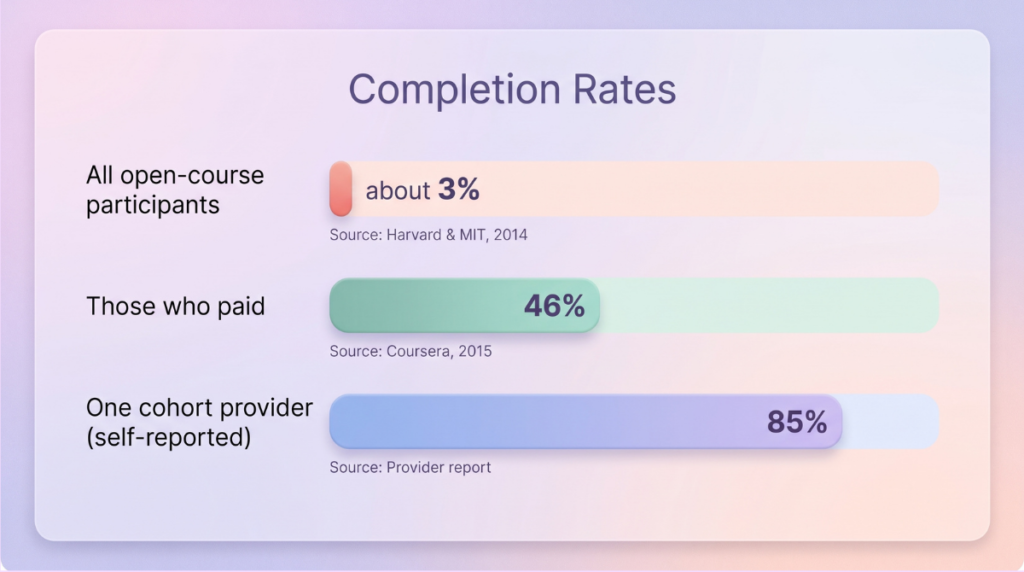
Course completion: about 3% of open-course participants, 46% of paying learners, 85% self-reported at one cohort provider
Structure closes more of the gap. Harvard Business School Online reports an 85% completion rate across its courses and says its cohort-based approach “likely contributes.” That’s one provider’s own number, so read it as a sign, not proof. For calibration, Ruzuku, a course platform, found that across 1.3 million enrollments its scheduled cohort courses finished at 53.4% and its self-paced courses at 41.9%. So on that platform, a set schedule added about 12 points: just over half of cohort learners finished, against about four in ten who went at their own pace.
Finishing still isn’t the same as changing how you work. In a 2019 Harvard physics study, students learned more from active class sessions than from polished lectures, yet felt they had learned less. “Deep learning is hard work,” said Louis Deslauriers, Harvard’s Director of Science Teaching and Learning. “The effort involved in active learning can be misinterpreted as a sign of poor learning.” I see the same thing in AI classes. You learn something in class and think, yeah, this looks great. Then you get off your computer and go, wait, what did I learn again? That’s why the questions in the next section matter more than any completion rate.
How do you tell if an AI bootcamp will change how you work?
Ask what happens between the classes: who checks your setup, whether you work on your own project, who looks at your homework, and how current the material is. Some programs sold as bootcamps are recorded videos with a bootcamp label, and these four questions sort them out quickly. This is the part of the AI bootcamp vs online course choice that sales pages skip, so ask them of any program, ours included. Here’s how we answer each one.
Does anyone check your setup?
A good AI bootcamp starts with the unglamorous part: your tools. Ours starts by putting every AI tool you use, and your prompt library, one click away. We check each setup by screenshot in the first two weeks, because I have a one-click rule: if anything has resistance, you won’t do it. If a program never asks to see your setup, you’re on your own for the step where most people quietly stop.
Do you move your own project through a process?
You should be working on something real, from start to finish. Every student in our bootcamp picks one project, usually from their own job, and takes it through every class. It doesn’t have to be work. A fun passion project counts, because whatever motivates you is what keeps you going, and the steps apply to any project. Valerie Bouagnon, an aerospace engineer who built the plan and brand for a new business during the bootcamp, said what set it apart from YouTube videos or a self-taught course was “how the course is built. The fact that you’re… working on a project for yourself.”
Does someone look at your homework and follow up?
Someone should look at your homework every week, give you feedback, and follow up with you when you’re falling behind. That’s what we do, and it’s the part people underestimate. In a March 2026 study hall, a student building a fundraising proposal told me she was behind on her homework. She had started strong: “at the first couple of weeks I was on, I was on task.” Instead of the whole proposal, I asked her for one small piece she’d be excited to make before the next class, like a budget table, a flow chart of the process, or a short document. She decided to catch up first and committed to a few days to put the document together.
Nobody scolded her. Someone noticed, made the next step smaller, and expected her back.
Lindsay G. Deefholts, a healthcare advocacy and communications consultant who had taken other courses, described how that feels from the inside: “checking in with us via text, checking in on Circle… You feel completely supported, but it’s not overwhelming.”
Is it live, and is the material current?
Ask whether the classes are live and when the curriculum was last updated. People ask me all the time why we don’t just record the bootcamp. My answer: record what? Everything changes. When I said that in May 2026, I had updated the curriculum a month earlier to teach Claude Cowork, and Claude Design had just launched, so I had to teach that too. So every month, we update the curriculum, and we teach it live in four two-hour classes, plus weekly one-hour study halls where we apply the week’s lessons to each student’s project. Every session is recorded within 24 hours, so a missed class isn’t a lost class. After the four weeks, students keep twelve months of access to our community, where people keep sharing what they tried.
How much does an AI bootcamp cost vs an online course?
An online course costs anywhere from nothing to about $59 a month, while bootcamps cost more and vary widely, so the better comparison is what each one gives back in hours. On the course side, Elements of AI is free. Google AI Essentials on Coursera costs $49 a month after a seven-day free trial in the U.S. and Canada, and Google says it takes under five hours. A Coursera Plus subscription is $59 a month or $399 a year for access to more than 10,000 courses. (Prices checked October 2026.)
Bootcamp prices are harder to compare. Most published ranges are for tech-career bootcamps that teach coding for a new job: about $1,000 to $5,000 at the lower end, with one 2026 review putting the average near $13,584.
For most people, the money is the smaller part of the AI bootcamp vs online course decision. Time is the bigger part. Our bootcamp takes four weeks, at about three to four hours a week, plus a week of onboarding. What you get back is time: students report saving about 10 hours a week early on, and 15 to 20 hours a week after three to six months. Ten hours a week over 50 weeks is 500 hours a year, and that’s the minimum baseline. So I’ll ask you what I ask everyone: what is 500 hours worth for you to get back?
We don’t want price to keep anyone out, so we use a sliding scale and a scholarship fund that offers partial scholarships. And there are two free ways to see how we teach before you settle the AI bootcamp vs online course question: the Free AI Masterclass, a weekly 60-minute live class (more on it at the end), and the free “Imagine: The Future of Work” Monthly Forum.
Should you take an online course before an AI bootcamp?
Yes, if you can: a free course gives you the basics, and a bootcamp then takes you much further with them. There’s so much good free content out there, and we love it when students have already taken some, because when they come through the bootcamp, they can go so much deeper. You don’t need a course first, though. We teach the basics along the way.
When people ask me about an AI bootcamp vs online course, my answer for many of them is both, in that order. Start with free material to learn what the tools do. Our guide to free AI courses worth your time is a good place to begin. If you want to feel what live teaching is like before committing, sit in on the Free AI Masterclass, our weekly live class on prompting for better results. Then, if you want AI to change how you work, take a bootcamp. By the end of it, you have a really good ability to keep learning on your own, so online courses become more useful afterward, not less.
AI bootcamp vs online course: Frequently asked questions
You can teach yourself a lot, especially the basics, and plenty of people should start there. What’s hard to teach yourself is a system: a setup you use every day, a way of giving AI your context, and a process you follow on real work. Ernanio Mandlate, a videographer and creative consultant in Mozambique, came into our bootcamp already using ChatGPT regularly and figured “anything extra would just be unnecessary noise. Boy was I wrong.” Afterward he said most people assume “I can just go on YouTube and watch a tutorial,” but “the best thing about AI Learning Labs is more this idea of creating a system.” If you’re weighing an AI bootcamp vs self study, try one free live class first and see whether you learn something a tutorial didn’t give you.
It’s worth asking, whichever side of the AI bootcamp vs online course question you land on, and the case is easier to make when you can show what your employer gets back. In our bootcamp, the project you work on can come from your own job, so you finish four weeks with a real piece of work, not just new knowledge. The time fits around a job, at about three to four hours a week. If your organization wants to train a whole team, it can also book private training with us.
Often from both, so on certificates the AI bootcamp vs online course choice is close to a tie. Many online course platforms offer certificates when you finish, and some bootcamps do too. Ours offers an optional Advanced Prompting Certificate, and graduates in career transition have used it to stand out and get jobs. A certificate shows you finished, and the project you built shows what you can do, so bring both to any conversation about your skills.
If you’re weighing an AI bootcamp vs online course for a career change into a technical job, look at tech-career bootcamps, which teach coding and machine learning for a new role. Our bootcamp is built for professionals who want to change how they work, and some career changers use it to make their skills easier to see. We cover that choice in our guide to an AI bootcamp for career changers.
An AI bootcamp is worth it if you’ll use what you learn every week. Start with one question: what would 500 hours a year be worth to you, since that’s the minimum time back we see. We work through the full math in our guide to whether an AI bootcamp is worth it.
Information or a new way of working?
So the AI bootcamp vs online course choice comes back to the question from the top: do you want information, or a new way of working? If you want to know how AI works or what the tools can do, take an online course, start with a free one like Elements of AI, and don’t let anyone sell you more than you need. If you want to change how you work, choose a program that checks your setup, puts your own project at the center, looks at your homework, and keeps its material current. Changing how you work is a human process, full of small points of resistance, and it takes practice with someone expecting you back. That’s what a live bootcamp is for: holding you through a process of experimentation where you learn the fundamentals, which you can then apply to everything. That’s the lens we bring to everything we teach.
Still deciding between an AI bootcamp vs online course? See a live class before you choose. The Free AI Masterclass is our weekly 60-minute live class on getting better results with Claude, ChatGPT or Gemini. Bring a question, watch how we teach, and decide from there. Join the Free AI Masterclass.
If you already know you want the full four weeks, here is our AI Bootcamp.
About the author. Nathaniel Reagan is co-founder and lead instructor of AI Learning Labs. He has spent 20 years in communications and development work, including five years in Mozambique in HIV behavior change communication. That work shapes how he teaches AI: live, on real projects, with someone checking in. He has trained 700+ professionals to use AI in the work they already do.